
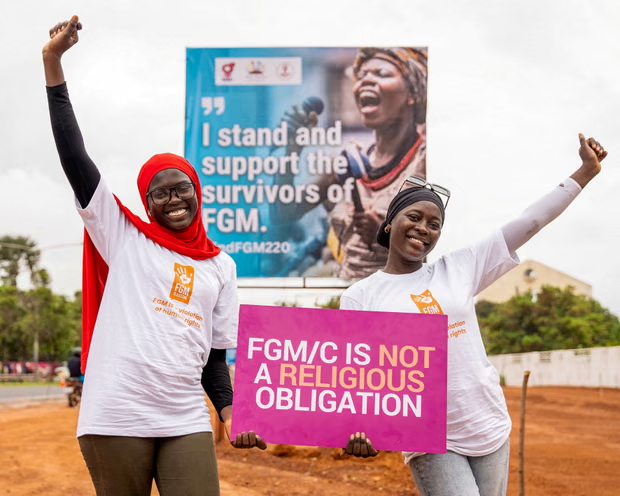
A new $15.5 million philanthropic fund is backing a growing global movement to end female genital mutilation (FGM), with its founders hoping to raise as much as $100 million to support the women and organisations already leading the fight.
The Her Horizon Fund, established by the US-based Wallace Global Fund, was launched at a time when efforts to eliminate FGM are facing an increasingly difficult financial and political landscape.
More than 230 million women and girls worldwide have undergone FGM, a practice that involves the partial or total removal of the external female genitalia for non-medical reasons. Although decades of advocacy have produced significant progress, campaigners warn that declining international funding and growing opposition to women’s rights could threaten those gains.
The new fund’s initial $15.5 million consists of $14 million from the Wallace Global Fund and $1.5 million from an anonymous donor. Its longer-term ambition is to mobilise $100 million from other donors and channel those resources towards organisations working to end FGM.
The urgency is underscored by the United Nations’ goal of eliminating FGM by 2030. Current progress, however, is not considered fast enough to meet that target.
Funding for some major programmes has also declined significantly. The joint UNFPA-UNICEF programme operating across 18 countries saw its funding fall by 45% last year, from $29.6 million to $16.3 million.
For grassroots organisations, reductions of that scale can mean fewer programmes, fewer people reached and less capacity to sustain years of community organising.
Somali-Irish activist and FGM survivor Ifrah Ahmed, founder of the Ifrah Foundation, knows that challenge firsthand. Her organisation works to end FGM in Somalia, where the practice remains almost universal.
Last year, the organisation lost $300,000 in funding from UNFPA, forcing it to look elsewhere for resources while continuing its advocacy and community work.
Despite the challenges, there have been signs of progress in Somalia. Three of the country’s seven federal member states have enacted anti-FGM laws, while two others have endorsed legislation banning the practice that is awaiting parliamentary approval.
But legislation alone cannot end a deeply rooted practice.
Across Africa, activists continue to confront cultural resistance, political uncertainty and gaps in legal protection. In The Gambia, for example, the Supreme Court is considering a constitutional challenge to the country’s 2015 FGM ban. That followed a 2024 attempt in parliament to repeal the prohibition, which was ultimately rejected after months of debate and strong opposition from women’s rights organisations.
In Sierra Leone, campaigners continue to call for stronger protection after the country’s new Child Rights Act stopped short of banning FGM.
The human cost of the practice remains enormous.
More than 144 million women and girls in Africa, 80 million in Asia and 6 million in the Middle East are estimated to have undergone FGM. Its consequences can include severe pain, heavy bleeding and infection, while survivors may experience chronic pain, psychological trauma and complications during childbirth.
A 2025 study estimated that FGM contributes to approximately 44,000 deaths every year across the 15 countries examined.
Yet the Her Horizon Fund is built around an idea that goes beyond simply putting more money into the fight.
It seeks to put resources directly behind the people who understand the problem from the ground up.
Susan Gibbs, senior adviser on women’s rights and FGM at the Wallace Global Fund, has argued that the world is at a critical moment. Years of progress have been achieved, but declining funding and the rise of anti-rights movements are creating new threats.
For the fund’s organisers, one answer is to strengthen frontline organisations, particularly survivor-led and community-based groups whose work is rooted in the realities of the communities they serve.
That means activists such as Ifrah Ahmed are not simply participants in the global response. They are part of the leadership driving it.
The hope is that sustained investment can help these organisations expand their reach, maintain long-term community engagement and build enough momentum to push societies towards a point where FGM can finally become a practice of the past.
The challenge is enormous, but so is the opportunity.
For generations, women and girls have lived with the consequences of a practice they did not choose. Ending it will require more than international declarations and short-term projects. It will require sustained political commitment, community leadership, survivor voices and the financial resources to turn those efforts into lasting change.
The Her Horizon Fund is placing a significant bet on that possibility: that when the women closest to the problem are given the resources and power to lead, the world can move closer to a future where no girl has to endure FGM.


More Stories
Femi Oyelade Turned His 50th Birthday Into a New Mission to Support Vulnerable Nigerians
Jennifer Esiaba Is Using AI and Basic Phones to Fix Nigeria’s Last-Mile Medicine Problem
Jean Lobe Lobe Is Building the Healthcare Infrastructure Africa Needs — and Just Won $250,000 to Scale It