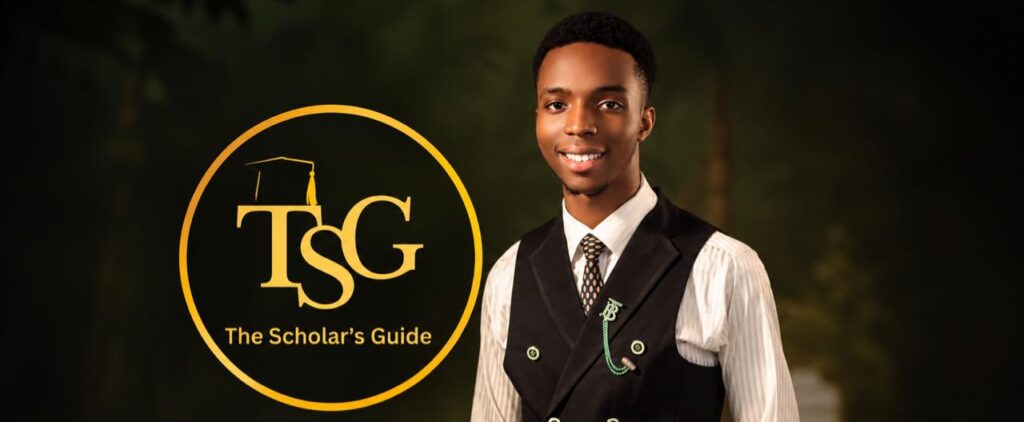
Bright Ekperebuikem Divine is a fourth-year medical student at the College of Medicine, Abia State University, with interests spanning medicine, cybersecurity, leadership and youth development.
His journey has not been without challenges. Losing his father at 13 significantly changed his family’s circumstances and disrupted his education. At some point, he had to stay away from school for a year due to financial constraints. He also took up small jobs, including working as a primary school teacher, while finding ways to continue his education.
Today, Bright is the founder of The Scholar’s Guide, a student-led initiative established in 2024 to make educational opportunities more accessible to African students. Through its social media platforms, the initiative connects over 18,000 students to local and international opportunities and has supported more than 300 students through mentorship, feeding stipends, academic resources and scholarship application guidance.
He has also participated in various leadership and development programmes, including serving as an Executive Delegate with Jamie Pajoel International. He is a Y-CLAP Fellow, an ambassador for the International Organisation of Youth and Ema4Kids Legacy Foundation, and a nominee for the 2026 FOYA Global Awards.
His work through The Scholar’s Guide has also received international recognition, with the initiative featured on The Leaders of Today.
In this edition of The Impact Lens (TIL), we speak with Bright about the experiences that shaped him, the intersection of his interests in medicine and technology, building The Scholar’s Guide, navigating opportunities and what he is learning about leadership, resilience and purpose as a young person still finding his way.
TIL: Beyond your achievements and titles, who is Bright Ekperebuikem Divine?
Bright: Beyond the titles, achievements and responsibilities, I am simply a young man who is still learning, growing and trying to make meaning out of life.
I am someone who believes that life should be about more than personal accomplishments. I value integrity, compassion, faith, discipline and the ability to make a difference in the lives of others.
I have experienced moments of uncertainty, financial limitations, personal loss and situations that have tested my resilience. These experiences have shaped how I see people and the world around me.
I am passionate about medicine, technology, education and youth development, but more importantly, I want to live a life that makes other people’s journeys a little easier.
I don’t want to be remembered only for what I achieved, but also for how many people found hope, encouragement or an opportunity through my existence.
TIL: Losing your father at 13 changed your life significantly. What is one lesson from that experience that has stayed with you?
Bright: Losing my father at 13 was one of the most defining experiences of my life. At that age, I was still a child who needed his father’s guidance, protection and presence. Suddenly, life became different.
My father was the headteacher and the primary provider for our family. His death in 2018, following complications from diabetes, left a significant gap in our family. My mother had to take on the responsibility of providing for us, and things were no longer as they used to be.
There were moments when I wished I could simply have my father around to ask questions, share my concerns or receive the kind of guidance only a father could give.
One lesson that has stayed with me is that life can change without giving you notice, and you must learn to keep moving even when life doesn’t turn out the way you imagined.
I also learned not to take the people in my life for granted. Sometimes, we become so accustomed to having people around that we forget how precious their presence is.
His absence has also influenced my desire to build a stable future, not just for myself but for my family. In many ways, some of the things I am working towards today are connected to the life I hope to build and the responsibilities I hope to carry.
I cannot bring back what I lost, but I can allow that experience to shape the kind of person I become.
TIL: You are studying Medicine, exploring cybersecurity and working in youth development. How do these different interests connect for you?
Bright: At first glance, they may appear to be unrelated interests, but I see a common connection: solving problems and improving people’s lives.
Medicine gives me the opportunity to understand human health, prevent diseases and contribute to better healthcare outcomes.
Cybersecurity introduces me to the world of technology, particularly the protection of digital systems, information and infrastructure. With healthcare becoming increasingly technology-driven, I believe there is an important intersection between medicine, technology and data security.
Youth development, on the other hand, allows me to contribute to people’s growth beyond the classroom. Through The Scholar’s Guide, I have seen how access to information, mentorship and opportunities can change someone’s direction.
I don’t necessarily see myself as someone who must choose only one interest. I believe there are meaningful ways to bring them together.
Ultimately, whether through treating a patient, protecting sensitive healthcare information or helping a student access an opportunity, my motivation remains the same: to make a meaningful contribution to society.
TIL: What inspired you to start The Scholar’s Guide, and what gap were you hoping to fill?
Bright: The Scholar’s Guide was born out of a desire to make educational opportunities more accessible to students, particularly those who have the potential and determination to succeed but lack the information, guidance or support they need.
Having navigated my own academic journey, I understood that opportunities do not always come to those who need them most. Sometimes, students miss scholarships, fellowships and other programmes simply because they don’t know they exist or don’t understand how to apply.
I wanted to create a platform where students could find opportunities, learn how to position themselves, improve their applications and connect with people who could guide them.
That vision became The Scholar’s Guide in 2024, with the motto, “Empowering Dreams, Inspiring Excellence.”
However, I have always wanted the initiative to be more than a platform that shares scholarship announcements. I wanted it to become a community where students could find mentorship, encouragement, academic resources and, where possible, practical support.
Over time, that vision has expanded into mentorship programmes, educational initiatives and our feeding initiative.
For me, the greatest motivation is knowing that someone might have a different story today because they encountered The Scholar’s Guide.
TIL: You have connected over 18,000 students to opportunities. What has building The Scholar’s Guide taught you about leadership and service?
Bright: Building The Scholar’s Guide has taught me that leadership is not primarily about occupying a position; it is about accepting responsibility for something bigger than yourself.
When I started, I had a vision, but I didn’t have everything figured out. I had to learn through experience, make decisions, manage people, build relationships and navigate challenges that came with running a growing initiative.
One important lesson is that impact is not always measured by the number of people who follow you or the recognition you receive. Sometimes, it is found in the story of one student who almost gave up but eventually secured an opportunity because someone shared the right information at the right time.
Today, reaching over 18,000 students is encouraging, but I don’t see it as a reason to become complacent. It is a responsibility to do more.
I have also learned that leadership requires humility. You cannot build something meaningful alone. I have people who contribute their time, ideas and energy to the vision, and I have learned to appreciate the importance of teamwork.
Most importantly, service has taught me that you don’t always need to have everything before you can help someone else. Sometimes, what you already know, the information you have or the experience you’ve gained is enough to make a difference.
TIL: As someone who has navigated scholarships and international opportunities, what advice would you give young Africans hoping to access them?
Bright: My first advice is to stop seeing scholarships and opportunities as something reserved for a particular category of people.
You don’t necessarily need to come from a wealthy background, attend the most prestigious institution or have an extraordinary story before you can be considered.
However, you must be intentional.
First, invest in yourself. Develop your academic profile, acquire relevant skills, participate in meaningful activities and take your personal development seriously.
Second, learn how to communicate your experiences. Many students have interesting stories, achievements and experiences but struggle to present them effectively in applications. Your ability to articulate your journey, motivations and future plans matters.
Third, don’t underestimate smaller opportunities. Volunteer experiences, leadership positions, local programmes and community engagements can gradually build a stronger profile.
Fourth, be consistent. I have encountered opportunities I didn’t secure, applications that didn’t receive favourable responses and moments when the process seemed discouraging. But I learned not to allow one unsuccessful application to define my potential.
Finally, don’t wait until you need a scholarship before you start building your profile. Prepare before the opportunity arrives.
And when you eventually get an opportunity, remember that it is not just about what you stand to gain but also what you can contribute.
TIL: You are involved in several leadership programmes and international networks. How have these experiences changed the way you see yourself and the world?
Bright: These experiences have helped me understand that there is so much more to learn beyond my immediate environment.
Interacting with people from different backgrounds, countries, disciplines and perspectives has broadened my understanding of leadership, collaboration and global development.
They have also challenged some of my assumptions about what is possible. I have come to appreciate that talent is everywhere, but access to information, opportunities and supportive networks is not always equally distributed.
Personally, these experiences have made me more confident in contributing to conversations beyond my immediate community. They have also reminded me that being part of an international network is not just about having an impressive affiliation or adding another title to your profile.
It is about what you learn, the relationships you build and the value you bring to those spaces.
I am still growing, but I now see myself as someone who can contribute meaningfully, irrespective of where I come from.
TIL: How do you balance your medical education, personal ambitions and the responsibility of leading an initiative?
Bright: Honestly, it is not always easy.
Medicine is demanding, and running an initiative like The Scholar’s Guide comes with responsibilities that do not necessarily wait until you have free time.
There are days when academic responsibilities require my full attention, while there are also moments when decisions concerning the initiative need to be made.
What has helped me is understanding that not everything requires my immediate attention. I have had to learn prioritisation, delegation and time management.
I also recognise the importance of having a team. The Scholar’s Guide has people who contribute to its operations, and I am learning that effective leadership does not mean doing everything yourself.
Academically, I remain conscious that my medical education is a major responsibility. I cannot allow my extracurricular engagements to undermine the very academic goals I am working towards.
I am still improving my approach to balance, and I don’t think I have mastered it. But I have learned to be intentional about how I use my time and to recognise when I need to refocus.
TIL: What is one thing you are still learning about yourself, leadership or life that people might not expect?
Bright: One thing I am still learning is that being strong and being human are not mutually exclusive.
Sometimes, when people see you consistently showing up, leading initiatives, achieving milestones and encouraging others, they assume you have everything figured out.
But that is not always the case.
I have moments of uncertainty, emotional struggles, disappointments and questions about life that I don’t necessarily share publicly.
I am also learning that I don’t have to carry every responsibility alone. As someone who started and leads The Scholar’s Guide, I sometimes feel a strong sense of responsibility for its continuity and the people who depend on the initiative.
But leadership also means building something that can function beyond your personal presence.
Another thing I am learning is to appreciate life and the people around me. Having experienced the loss of my father at a young age, I have become particularly sensitive to death and the possibility of losing people. It has taught me not to take human relationships, time and the presence of loved ones for granted.
I am learning that life is not just about how much you accomplish, but also about how well you live, the relationships you nurture and the person you become along the way.
TIL: If you could speak to young people coming behind you, what three lessons would you want them to learn from your journey?
Bright: One thing I would love young people to understand is that your background should inform your story, not determine your destination. I understand what it means to experience limitations, uncertainty and circumstances beyond your control. But I have also learned that where you start does not have to determine where you end. Don’t allow your present circumstances to convince you that your future is already decided.
I would also encourage them to build themselves before seeking recognition. Don’t become so obsessed with titles, awards, certificates and visibility that you forget to develop the substance behind them. Acquire knowledge, develop relevant skills, build meaningful relationships and become someone who can contribute value wherever you find yourself. Recognition may come, but let competence and character come first.
Finally, don’t make success entirely about yourself. As you grow, find ways to make life better for other people. Share information, mentor someone, support a struggling student, volunteer your time or create something that addresses a problem in your community. You don’t have to be wealthy or occupy an influential position before you can make an impact.
I would also tell them that they don’t need to have their entire lives figured out at a young age. Take your steps, learn from your mistakes, remain teachable and keep growing. Your journey does not have to look like someone else’s for it to be meaningful.


More Stories
Taraba Joins 25 States to Launch Nigeria Learning Passport, Expanding Access to Digital Education
Akunedozi Foundation Plans to Expand Scholarship Scheme for Disadvantaged Students in Abuja
Adedolapo Osuntuyi: Building a Future Where No Child Is Left Behind