
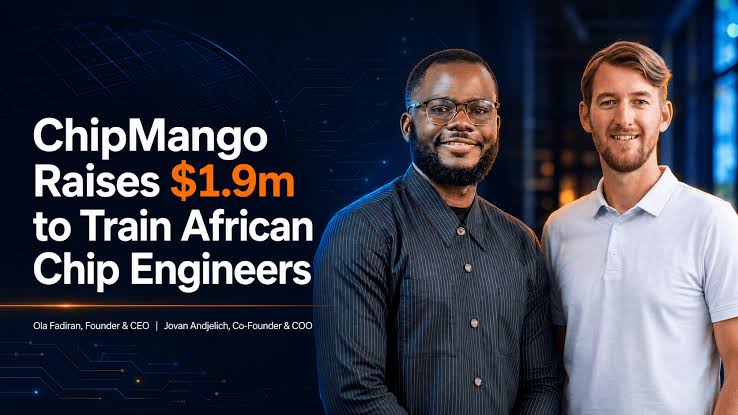
Nigerian technology startup ChipMango has raised $1.9 million in seed funding as it expands its work in semiconductor engineering, artificial intelligence and intelligent hardware across Africa and international markets.
Founded in 2022 by Ola Fadiran and Jovan Andjelich, ChipMango is building a business around an area of technology that is rarely associated with Africa: chip design.
The company does not manufacture physical semiconductors. Instead, it focuses on the engineering side of the industry — designing and verifying chips, developing edge-AI technology and training engineers to work on commercial semiconductor projects.
That distinction matters.
As artificial intelligence becomes increasingly important, the conversation is often centred on software, applications and data.
But behind every AI system are physical components that make the technology possible.
Those components require highly specialised engineers who understand semiconductor design, verification and hardware development.
ChipMango is betting that more of that expertise can be developed in Africa.
The company was founded by Fadiran and Andjelich and has built engineering operations involving Nigeria, South Africa, Rwanda and other international markets.
Its model combines workforce development with commercial work: engineers receive industry-aligned training and then gain experience working on real semiconductor projects for global customers.
The new $1.9 million funding round was led by Atlantica Ventures, with participation from DFS Labs, Madica, Kaleo Ventures, Trilinear Technologies and Malta Ventures.
ChipMango plans to use the capital to expand its engineering and product teams, take on additional commercial design projects and develop its AI-native learning and workforce platform.
The company is also expanding its work in edge AI and intelligent sensors.
Beyond its African operations, ChipMango plans to establish a European design centre in Malta and support initiatives in Kigali, Rwanda focused on semiconductor skills, workforce development and AI infrastructure.
For Africa, the opportunity is significant.
The continent currently represents a very small share of the global semiconductor industry, despite having a large and growing pool of young engineers.
ChipMango’s approach does not require Africa to immediately build expensive semiconductor manufacturing plants.
Instead, it is targeting the design and engineering layer of the industry, allowing African engineers to participate in high-value global technology work from the continent.
The company is already working with academic and technology partners, including the Carl Emily Fuchs Institute for Microelectronics at the University of Pretoria, to help connect university training with the requirements of commercial semiconductor engineering.
For co-founder and CEO Ola Fadiran, the future of AI will depend on more than software.
It will also depend on who can design the chips, systems and intelligent hardware that power it.
That is the space ChipMango wants African engineers to occupy.
The $1.9 million investment is therefore more than a funding milestone for one startup.
It is a bet that Africa can become a contributor to the technology underneath the next generation of AI, not simply a market that consumes it.


More Stories
Ugandan AI Startup, SANDI AI Wins $50,000 to Help Farmers Access Finance
Nomba Bets on Better Payment Infrastructure to Connect African Businesses to Global Trade
MTN Establishes Africa Data Hub to Accelerate AI-Ready Data Centre Infrastructure Across Africa