
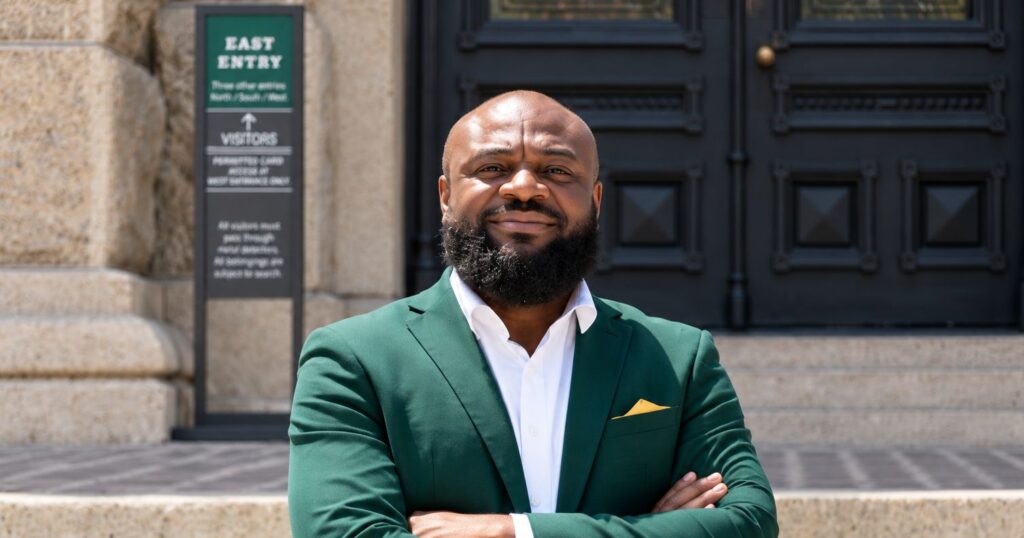
We tend to meet boys too late.
We notice them when they are failing at school, when their behaviour becomes difficult, when they begin disappearing into the streets, when the police become involved, when a father finally realises he has lost connection with his son. By then, the story has usually been unfolding for years.
Owolabi Williams has spent much of his life thinking about those years we do not see.
The years before the crisis. Before the offence. Before the young man becomes a statistic. Before the world begins asking what went wrong.
His journey has taken him from Lagos to the United States, from youth ministry and mentoring into the juvenile justice system, and eventually into a life devoted to the development of boys and men.
But what makes his story worth telling is not simply where the journey has taken him.
It is what he chose to do with what he saw along the way.
Years ago, Williams sat across from young men whose futures had already been marked by the justice system.
Today, he is part of international conversations about what the future of boys should look like.
The distance between those two rooms is the story.
Williams did not set out to spend his life answering this question. There was no obvious line connecting the boy he was in Lagos to the man who would one day sit at tables discussing the development of boys and young men across borders. His life seems to have gathered its meaning gradually, through experiences that might once have appeared to belong to entirely different chapters.
The more I followed the story, the more those chapters began to speak to one another.
Williams grew up in Lagos and has described himself as a restless child. He missed school. He fought. He found himself drawn towards the streets and the belonging they could provide. He has also spoken publicly about an attempted sexual assault during his youth, an experience that exposed him to a kind of vulnerability that boys are rarely taught how to name.
But Williams did not simply carry those experiences forward as wounds.
That, to me, is one of the most compelling things about his story.
He could have walked away angry.
Instead, he moved towards the problem.
After moving to the United States, Williams became involved in youth ministry and mentoring. He studied psychology because he wanted to understand young people better and become more effective in helping them.
Then he entered the juvenile justice system.
It is difficult to imagine a more confronting classroom for someone already interested in young people.
The boys and young men Williams encountered were not being discussed as possibilities. They were being processed through a system because something had already gone badly wrong.
Some were serving extraordinarily long sentences. Some spoke about growing up without positive male influences or father figures. Some had learned to navigate life largely on their own. Some had found belonging in gangs.
And Williams listened.
What he heard appears to have changed the direction of his life.
He would later describe young men serving sentences so long that they would never see the outside world again. Many told him they had grown up without positive influences, had been forced to fend for themselves and had found belonging in gangs. After less than two years in the prison system, Williams resigned and started Boys Lead Foundation.
Behind the young men in front of him were younger versions of themselves. Before the sentence, there had been a childhood. Before the offence, there had been years of development. Before the system met the young man, there had been a boy being shaped by a family, a neighbourhood, a peer group, a school and the men around him.
The system was meeting the consequence.
Williams became interested in the formation that had come before it.
It is easy to ask what a young person did. It is harder to ask what happened to him. Harder still to ask what we might have done differently while he was still becoming.
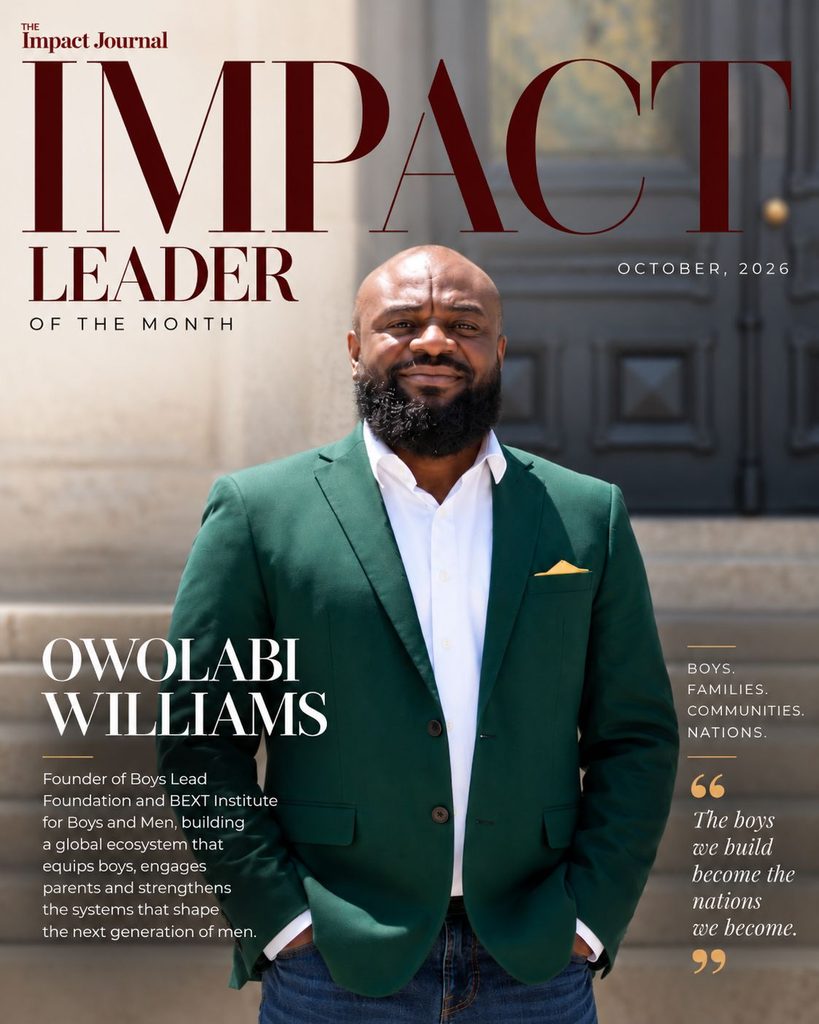
And in 2017, Williams founded Boys Lead Foundation around that conviction.
The organisation focuses on mentoring, leadership, education, character formation, entrepreneurship, skills development and community engagement. Its work has reached more than 20,000 boys and young men across the United States, Canada, Nigeria, the United Kingdom and other communities internationally.
I kept thinking about that number.
More than 20,000 boys and young men is not simply an impressive impact figure. It tells us something about the length and seriousness of the commitment. One boy can take patience. One boy can take years. One boy can require a mentor to keep showing up when there is no immediate evidence that anything is changing.
To have reached more than 20,000 means the work has had to become something larger than individual acts of mentorship. It had to become an ecosystem.
That is perhaps the clearest way to understand what Williams has built.
The more I looked at his work, the more I realised that he was not only asking how to reach boys. He was asking what would have to be true around a boy for that work to last.
A wholesome boy cannot be built by talking to the boy alone.
Someone has to think about the home he returns to, the school he attends, the men he sees, the expectations placed on him, the communities that surround him, the systems that respond when he struggles, the opportunities available to him and the adults who are themselves responsible for helping him become.
His 5E Method of Boys Development, Embrace, Engage, Equip, Express and Elevate, gives structure to that process. But perhaps the more revealing evidence is what Williams chose to write about.
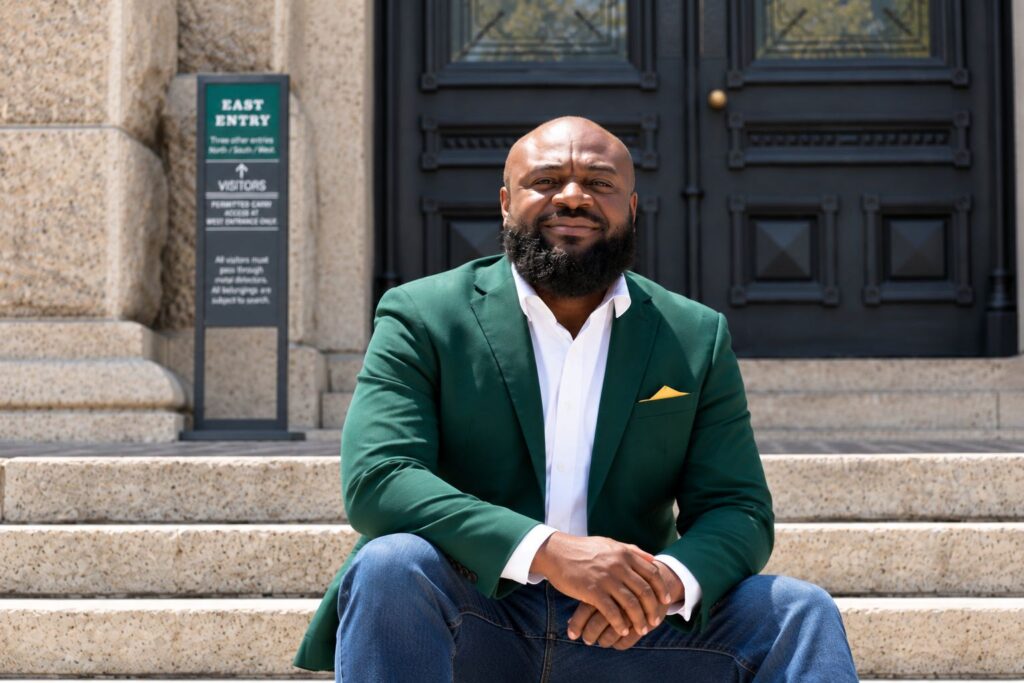
His books move through the ecosystem around a boy.
The Boys We Build, The Nations We Become takes the conversation to its widest level. It asks us to think about the relationship between the boys we raise and the societies those boys will eventually help shape.
Then there is The Art of Mentoring Boys, which speaks to the people who choose to walk deliberately alongside them.
Presence Is Not Enough turns the attention towards fatherhood and the difference between being physically present and being meaningfully involved.
Dear Son speaks directly to boys and young men. Dear Moms of Boys recognises the mothers who are part of the daily work of raising sons.
And 52 Days of Father and Son brings the father and son relationship into focus in a practical, relational way.
When you put those works beside one another, the pattern becomes difficult to miss.
He is not writing the same book repeatedly. He is speaking to the different people who stand around the boy.
The boy needs to hear something. His father needs to understand something. His mother needs to understand something. His mentor needs to know something. His community needs to consider something.
And eventually, the nation has to ask something. It is a remarkably deliberate way of approaching social change.
Williams appears to have understood that you cannot sustainably transform a boy while leaving the ecosystem around him untouched.
This is also why his work has continued to expand beyond individual mentoring.
The Global Boys Summit brings boys, parents, educators, practitioners, community leaders and institutions into the same conversation. His work has taken him into conversations with civic and public leaders and increasingly towards questions of policy, institutions and the systems surrounding boys.
More recently, he has begun building structures that allow other organisations and communities to take up the work themselves.
There is something significant about that evolution.
He first saw boys in crisis. Then he began mentoring them. Then he built an organisation. Then he developed a framework. Then he began bringing different parts of society into the conversation.
It is the progression of someone who has discovered that reaching one boy is important, but changing the environment in which boys are formed may be even more important.
There is another part of Williams’ story that makes this personal in a different way.
He is now a father.
The questions he has spent years asking about presence, responsibility, guidance and the making of boys are no longer only professional questions. They live inside his own home.
It is one thing to speak about fatherhood from a distance. It is another to become responsible for raising a child yourself and realise that the things you have spent years teaching others must also be lived.
You can see that shift not only in the way he speaks about fatherhood, but in the way he has chosen to model it. In Boypreneur: From the Ground Up, You Got This, written with his son, Williams does something that feels especially revealing in the context of his wider work. He is not simply telling his son what it means to become a man. He is creating something with him.
The book introduces another dimension to the way Williams sees boys. They are not only young people who need to be guided, protected or corrected. They are capable of creating, building and contributing. And perhaps there is something particularly powerful about a father teaching that lesson not only through his words, but by inviting his son into the work itself.
Perhaps the work has given him a different kind of inheritance.
He has seen what the absence of intentional guidance can cost. He has seen what can happen when boys find belonging in unhealthy places. He has seen systems meet young men only after years of missed opportunities.
And now he has the opportunity to do differently. Not perfectly. Differently.
That, to me, is one of the quiet strengths of his story.
His life does not feel like a collection of unrelated achievements. It feels like a question that kept getting bigger.
Through Boys Lead Foundation, the Global Boys Summit, his books, the 5E framework and his wider advocacy, Williams has continued to push the conversation beyond what happens to an individual boy and towards what happens in the environments that form him.
The young men he encountered in the juvenile justice system could have become the endpoint of his thinking. Instead, they became part of the reason he chose to move further upstream.
And now the question is no longer simply how to help one boy.
It is whether the systems around boys can become better at helping them before they reach crisis.
Whether fathers can become more intentional. Whether mentors can understand that showing up is only the beginning. Whether schools can see development as more than academic performance. Whether communities can give boys healthier pathways into adulthood.
But perhaps Williams’ life explains why he keeps asking them.
He has seen what can happen when boys are left to navigate important years without enough guidance.
He has also seen what becomes possible when someone chooses to stay. That may be the most human part of his story.
For Williams, the goal is not to create boys who never struggle. He knows too well that struggle is part of growing up.
The goal is to ensure that a boy does not have to navigate every struggle alone.
And perhaps that is what has kept him doing this work for so long. Not the belief that he can save every boy, but the conviction that we should not wait until a boy is in trouble before we decide that his life matters.
Perhaps, that is the thread that holds Williams’ story together.
We tend to meet boys too late.
Williams is spending his life trying to make sure we don’t.
And perhaps, in the end, that is what all this work is really about: meeting the boy early enough to help shape the man.



More Stories
YHLDI to Mark International Day of the Girl Child With Girls’ Empowerment Event in Ondo
Beyond Enrolment: MAYEIN Calls for Action on the Barriers Keeping Oyo Girls in School
Mary Sabo Olowoloba Builds Nigerian Solution to Tackle Period Poverty