

Some entrepreneurs begin with a business idea. For Tabitha Arenson Abimiku, the journey began with a problem she kept encountering in the lives of girls and women.
Over the years, that problem has taken her from community outreach and menstrual-health education to building a social enterprise, developing reusable menstrual products, training women, exploring technology and data, and creating new models for women to participate economically in solving the challenges around menstrual health.
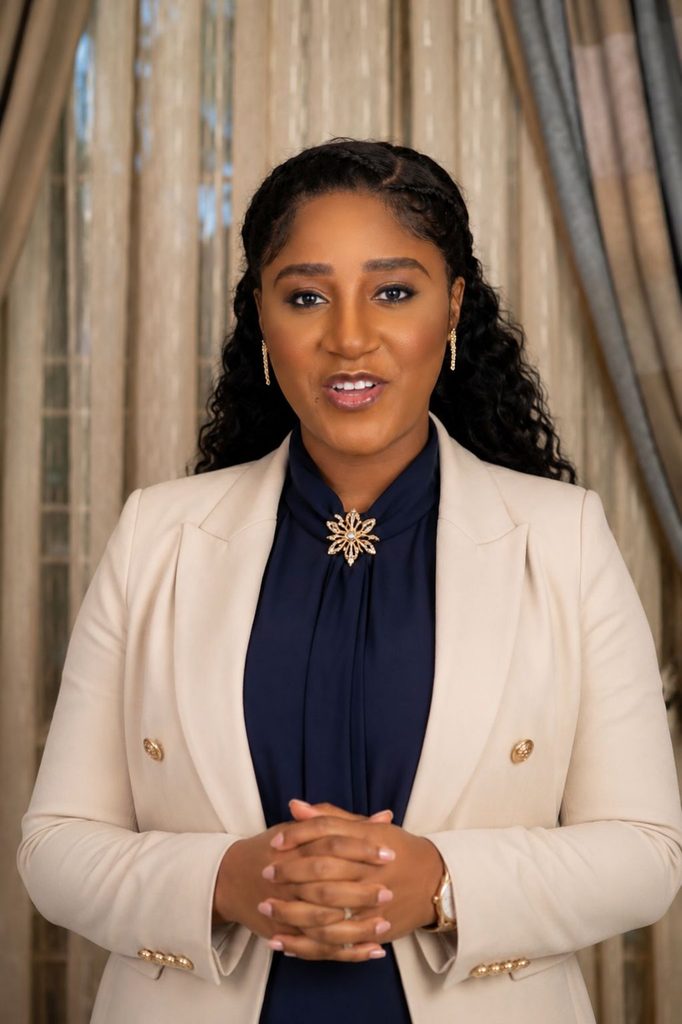
Today, Abimiku is the Executive Director of Virtuous Reusable Pads and the founder of HerBloom Technologies Africa. Her work sits at the intersection of menstrual health, women’s empowerment, technology, entrepreneurship and social impact.
But none of that was part of the original plan.
With a background in medical microbiology, Abimiku understood health from a scientific perspective. Her interest in menstrual health, however, became much more grounded through her work with girls and women in underserved communities.
She began seeking out communities where girls were struggling to manage their periods and started providing sanitary products and menstrual-health support.
Her work eventually took her into internally displaced persons’ camps, where the realities surrounding menstrual health became even more visible.
There were girls who did not have reliable access to sanitary products. There were conversations around shame and misinformation. There were families struggling with basic needs. And there was the recurring question of what happened after the donated products ran out.
For Abimiku, that question became increasingly difficult to ignore.
Providing pads could solve an immediate problem. But menstruation was not an occasional problem. Girls needed support every month.
The search for a more sustainable solution eventually led her to reusable menstrual products.
That thinking became the foundation for Virtuous Reusable Pads.
Abimiku began developing reusable sanitary pads as a more affordable and sustainable option for women and girls, particularly those living in communities where access to disposable products was difficult.
But the idea did not remain a small community intervention.
She began building a social enterprise around it.
Virtuous Reusable Pads grew into an organisation working across menstrual-product access, menstrual-health education, community outreach and reusable-pad production.
The company also began training women in pad production, introducing another dimension to the model: the women experiencing the problem could also become part of the solution.
This became an important thread in Abimiku’s work.
She was not interested only in asking how many pads could be distributed.
She was increasingly interested in what could happen when communities had the knowledge and capacity to produce their own.
Building Virtuous required Abimiku to move between two worlds.
One was social impact: girls, women, schools, communities and the realities of period poverty.
The other was entrepreneurship: production, machinery, staff, markets, revenue and growth.
Her participation in programmes including the Tony Elumelu Foundation, the AGS Enterprise Challenge, Rising Tide Africa and the African Diaspora Network’s Builders of Africa’s Future fellowship helped provide opportunities to strengthen and scale the enterprise.
Tony Elumelu Foundation support helped Abimiku acquire machinery and significantly increase production capacity, transforming Virtuous from a small operation into a more established enterprise.
The growth also meant that the work could reach beyond the communities where Abimiku had initially intervened.
Virtuous developed into a platform through which menstrual products, education and production training could reach more women and girls.
It would be easy to describe Abimiku simply as a reusable-pad entrepreneur.
That description, however, leaves out much of what she has been building.
Her work increasingly moved towards the broader questions surrounding women’s health.
Why do girls lack accurate information about menstruation?
Why do women have limited access to health information and services?
What role can technology play?
What can data tell us about women’s health?
And how can women participate economically in solving problems that affect them?
These questions eventually led to another venture.
Abimiku founded HerBloom Technologies Africa, a FemTech organisation focused on women’s health, technology, research, data and gender equality.
HerBloom’s work includes digital solutions for women’s health, analytics, research and community engagement.
The move into technology was not a departure from the work she had already been doing.
It was an expansion of it.
Virtuous Reusable Pads addressed menstrual health through physical products, community engagement and production.
HerBloom created an opportunity to approach women’s health through technology, data and research.
Together, they reveal a broader ambition behind Abimiku’s work.
She is increasingly interested not just in creating a product that solves a problem, but in understanding the systems that allow the problem to persist.
One of the strongest ideas running through Abimiku’s work is the shift in how women are positioned.
In many development interventions, women are presented primarily as beneficiaries.
Abimiku’s work increasingly asks a different question:
What happens when women become producers, entrepreneurs and owners of the solutions created around their needs?
That question has influenced Virtuous’ work in reusable-pad production and training.
It has also shaped the direction of her more recent work.
And it is this thinking that has now found a new expression in Gombe.
In August 2026, Virtuous Reusable Pads launched the Pads to Prosperity Community Pad-Making Enterprise Programme in Gombe State.
Gombe was selected as the pilot state for the programme, which is fully funded by the North East Development Commission and implemented by Virtuous Reusable Pads, with HerBloom Technologies Africa serving as technical partner.
The programme is designed to take the idea of local production further by equipping women with the skills and infrastructure to produce reusable sanitary pads while creating opportunities for enterprise development.
The biggest highlight of the launch was the unveiling of the architectural ground plans for four proposed Community Pad-Making Enterprise Hubs across Gombe, Dukku, Funakaye and Yamaltu Deba Local Government Areas.
For Abimiku, the significance of the initiative is not simply that more pads will be produced.
It is that women can gain the skills and infrastructure to become part of the production economy.
The programme’s theme, “From Skills to Sustainable Enterprise: Building Health, Creating Wealth, Transforming Communities,” captures that progression.
It is also consistent with the direction Abimiku’s work has been moving in for years.
There is a clear progression in Abimiku’s story.
She started by responding to a problem affecting girls and women.
She developed a product.
She built an enterprise around that product.
She expanded into education and community engagement.
She explored technology, research and data through HerBloom.
And now she is building models that place women themselves closer to the centre of production and economic opportunity.
The evolution matters because it shows that her work has never really been about sanitary pads alone.
The pad was the entry point.
The bigger question has always been what women and girls need to live with greater dignity, knowledge, opportunity and agency.
That is why her work has continued to expand.
And perhaps that is also what makes Abimiku’s journey worth watching.
She is not simply building a company around a product.
She is building, piece by piece, a broader ecosystem around a problem she has spent years trying to understand.
From menstrual-health products to education, from production to technology, from community intervention to enterprise development, Tabitha Arenson Abimiku’s journey reflects a social entrepreneur continually asking the same question in new ways:
What would it look like to build solutions that do not just serve women, but give women the power to build, own and sustain those solutions themselves?



More Stories
UK Launches Women in Tech Taskforce to Tackle Barriers to Career Growth
Oluwatoyin Falaiye: The Making of a Voice for Justice, Healing and Restoration
Damilola Uzoma-Udoma: Helping People Discover Purpose and Find Direction