
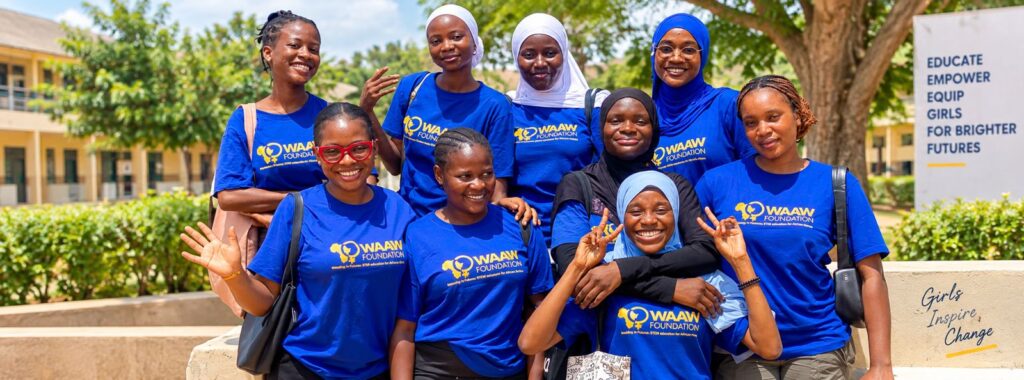
A girl’s interest in science and technology can begin with a classroom lesson, a teacher who encourages her, or the opportunity to see what is possible in a STEM career. But whether that interest grows into a real pathway can depend on much more, the quality of her learning environment, access to functional laboratories and equipment, the support available to her teachers, and the opportunities she has to see herself in the world of science and technology.
For girls in government secondary schools, these opportunities and resources can be uneven.
This is the gap that WAAW Foundation is seeking to examine and address through a new advocacy project focused on science and technology education for girls and science teachers secondary schools across the Federal Capital Territory (FCT), with support from Rise Up Together.
The project, “Advancing Science & Technology Education for Girls in FCT Rural Area Councils,” officially launches on July 6, 2026, with a focus on the six Area Councils of the FCT.
At the heart of the initiative is a policy advocacy effort focused on the National Policy for Science and Technology Education. WAAW Foundation is seeking to support the development of an FCT-specific Science and Technology Implementation Roadmap that translates the national policy into coordinated, actionable and gender-inclusive programmes for girls and female teachers across the FCT’s rural and suburban Area Councils.
The proposed roadmap is also intended to include an action plan within the FCT Department of Science, Technology and Innovation’s annual budget cycle, helping to create a clearer pathway for resources and interventions that respond to the realities of underserved communities.
To build the evidence and support needed for this advocacy, WAAW Foundation and its partners will undertake research, stakeholder and community engagement, capacity-building and public education activities to better understand the gaps affecting girls’ participation in STEM and build support for practical solutions.
“We cannot encourage girls to pursue STEM without also paying attention to the environment in which they are learning. We need to understand what is happening in our schools, what resources teachers have, what girls are experiencing and where the gaps are. That evidence is critical if we want to advocate for solutions that actually respond to the realities of these communities,” said Timi Onafeso, Executive Director, WAAW Foundation.
The project will also bring together civil society organisations, government stakeholders, educators, women and girls and other relevant actors to strengthen the advocacy process and develop a shared understanding of the challenges and opportunities surrounding STEM education in underserved communities.
“We want to bring the evidence, the people and the policy conversations together. Girls and female teachers in these communities should not simply be beneficiaries of decisions made about STEM education; their experiences should help shape the conversations and the solutions,” Onafeso added.
As part of the advocacy process, WAAW Foundation will work with civil society organisations and other stakeholders to review the National Policy for Science and Technology Education, examine the current state of science and technology education in the FCT’s suburban Area Councils, and develop a consensus advocacy position with actionable, gender-inclusive recommendations.
Although the project is focused on the FCT, the evidence generated from the work is intended to contribute to broader conversations about how Nigeria can strengthen science and technology education for girls, particularly in communities where access to resources and opportunities remains limited.
For WAAW Foundation, the starting point is the FCT, but the larger question is how evidence from these communities can help inform better decisions about the implementation of science and technology education policy and the future of STEM education for girls across Nigeria.



More Stories
YHLDI to Mark International Day of the Girl Child With Girls’ Empowerment Event in Ondo
Beyond Enrolment: MAYEIN Calls for Action on the Barriers Keeping Oyo Girls in School
HOW OWOLABI WILLIAMS IS HELPING BOYS BECOME THE MEN THEY ARE CAPABLE OF BECOMING